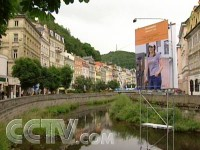
My earliest impression of the West was from a popular Chinese quiz show. 正大综艺, roughly translated as "The Magnificent Variety Show," started airing in 1990. Everybody I could know as a toddler watched it religiously. The show featured clips of the gallivanting reporters adventuring in various European hotspots, followed by short trivia questions with guests. Often there was a foreigner with colorized facial features, speaking extremely offkey yet admirable Chinese.
The unabashed level of cosmopolitanism and urbane exoticism, of European row houses with roofs red and blue, bordering meandering canals or cobbled walkways, starkly contrasted with the environment of most viewers. Back then almost everybody lived in a cell in a honeycomb, inside some drab grey concrete midrises. The less fortunate were in a farmhouse, often a single incandescent bulb dangling on wire illuminated the hearth with dirt walls. At least when I watched the show, the Chinese pavements outside lined with peddlers of goods and groceries, the openair cookstands enshrouded in mist, paled in comparison, to the serene meadows and orderly street of the old European bourgeoisie.
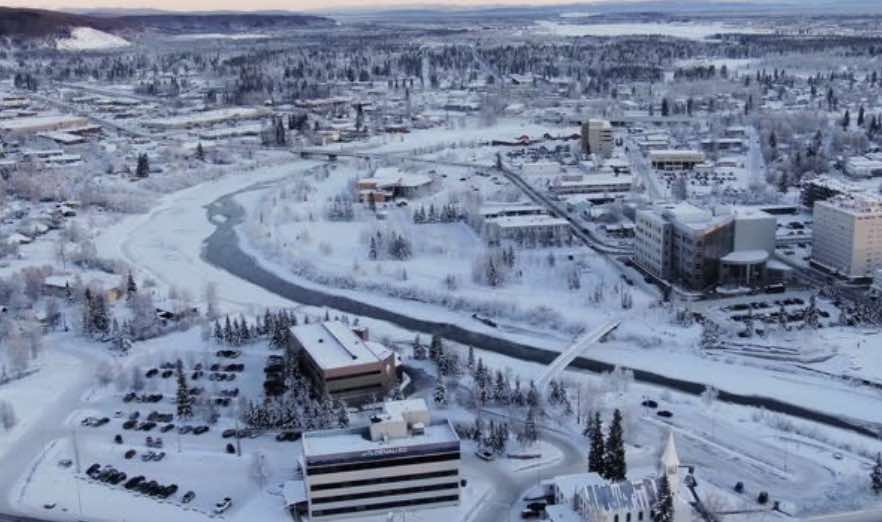
When I found myself in the West, it was in 2003 deep within interior Alaska, an hour or two of driving from the actual Arctic Circle. I wasn't transplanted into the postcard, moreso into a blank canvas that I had to repopulate myself.
First there were the ubiquitous corrugated iron and aluminum boxes, so utilitarian in form that rarely revealed its utility. Then there were decades-old wooden huts and shacks, forming the majority of the common dwelling. In more dense areas, by American frontier standards, one could find concrete structures most under 5 stories tall. The color scheme was an interminable whiteness for the majority of the year, strangely reminiscent of Chinese watercolor painted in sparing negatives. For the rest season and a half, the whole landscape came alive with foilages greens and brown.
I could only describe my entrance into America, as rebirthing as a toddler at 10. I was handed another tabla rasa without tools, and had to fill it with brand new signs and symbols of a new language, mapping what they signified. Far from being jaded enough as a preteen, I took in people and things looking like nothing before as they were, without the preconceptions that preoccupied or sometimes even intimidated my parents.
Just two days after my arrival, they threw me into an intensive ESL course in the downtown school district admin building. In a few briefs minutes, the overpriced English lesson I attended in China taught an Irishman in Chengdu last spring proved to be not only insufficient but also misleading. I wasn't discouraged or intimidated by any means. There were still some sparks in my eyes at that age back then and I took on everything with a peppy curiosity. Gary, the instructor, always dressed in characteristically America collared tartan shirt, always stretched and gaped his mouth fully wide, to pronounce the wide and loud American English "o" and "a." Even in my most caricatured attempts, it seemed to barely pass the level of exaggeration needed to mimic American openness.
Conveniently, Gary the instructor also volunteered at the local Baptist Church that doubled as the unofficial Chinese community center. The Taiwanese dissenter aptly named Grace shoved me into Gary's Sunday youth Bible study, promised to me as a double portion of ESL freebie. That summer, in between memorizing the lyrics secular Billy Boy and Amazing Grace, I built a foundation of American English without clear separation of church and state.
The Baptist Church had been a check-in for new Chinese arrival for more than a decade. Most are lured by the Friday Night potluck, featuring Chinese dishes made by better established immigrants who managed to source a variety of authentic spices that the fresh off the boat often neglected to consider their lack of availability in the US. Thus to have a taste of just one or two in the 5-spice mix, dashed with a hint of spicy bean paste, lots Chinese Gen X'ers would forgo immediately the communist society's openly atheist lines and step in the territories of overt dissenters. In my half of decade of attending this Friday fixture, I found that the yield of returning attendees to be in the 2 out of 3 range. And after singing the Chinese translated hymns after a handful of dinners, they find themselves bothering to wake up fully semi-formally dressed, and attend the Sunday morning worship, for the guise of getting closer to God in authentic American English.
My family held off falling into the religious furor, and managed to squeeze out many secular gatherings from the people we met in the Baptist church basement. We arrived in June, arguably the best time of the year in Alaska when the sun was interminable and even the most sleep starved could get by on 5-6 hours a day. The most common form of gathering was outdoor barbecuing, either in the ubiquitous backyard or surrounding park grills. The early 2000s American price levels were even shocking by Chinese standards. Chicken could be had for under a dollar a pound, and beef barely more than double the price. Everflowing supplies of ersatz fruit drinks, teas and sodas, came in gallon sized jugs for a few coins.
What I remember most fondly, was visiting my father's professor's home. It was first American postcard American single family home I visited, which was owned by a Chinese man arrived a decade earlier from the provinces. It featured a backyard and SUV parked in front of the garage revealing the tools and clutter inside, albeit no picket fence because nobody bothered with those on the rather large plots common in Alaska. Prof. H had a daughter a year younger than me, born in America and spoke Chinese worse than my English. For two functionally mute preteens, we hid in her American teenager's large bedroom while she showed me flash games on her computer that required little language comprehension. I rolled around on her large mattress, admired the plentitude of her girl chachkies and playthings. I enjoyed frequenting Prof H's home, since the whole endeavor seemed, aspirational, and demonstrated possibility if we had the endurance and patience, to walk down the same path their family had.
-
My departure to America, was anything but planned in the eyes of the peers of my Chinese recent past. It's not overly hyperbolic to say, in a uniquely cultural and academic background, that the then 10-year-old me was a linchpin in a lot of the daily functioning of Chengdu's Chenghua Experimental Primary School. I was the official announcer of both the morning pre-class and morning recess broadcasts. Also I was part of the year end official performance, where I took up a major speech recital for the year of 2003. When my parents suddenly removed me from this picture, suddenly there was both a large gap in the early morning pop-song show case, and also 30 seconds of unfulfilled space in the performance shown to city officials.
So in that summer, when I was trying to piece together the difference of past tense versus perfect tense on my father's hand-me-down Dell laptop in his lab office with never before experienced broadband internet, I was procrastinating to log on to QQ for almost a month to experience the blowback and scolding from my sudden absence. I retreated to my familiar Chinese BBS, rebranded to Student Kingdom, and found myself some Chinese online girlfriends, and cameoed in many pop song sing alongs. The summer of 2003 also saw the release of the Tencent version of Chinese online Bomberman, which I squeezed in many sound-off games while my dad was not in direct view of my computer screen.
-
After three years I entered high school. By then I had no more qualms about the place that I called home. I was fully competent in the language, sometimes felt even superior to the locals who learned an imperfect version via osmosis. My English was acquired the same way many adult Chinese student-immigrants had to toil through: memorizing whole tomes of language test prep material, oddly nicknamed as gems such as ruby or sapphire -- much like the Pokemon games popular among children. At times I was even asked to tutor new arrivals and their spouses, in "authentic English" from someone who still had a decent command of Chinese.
I was barely 14 then, not too far removed being a preteen, not old enough to be a troubled adolescent. Gradually though, it became more clear that I was staring down a branched path in my development. The more time I spent playing volleyball with the Chinese club, and tutoring some of the students I had, the less concerted effort I could put into befriending people in my school and be invited to their gatherings.
Other young immigrants in my situation, more likely belonged to families that converged in large metropoles in California or New York. These diaspora populations were large enough to furnish similar aged immigrants. The interior Alaska town of Fairbanks had a population of barely 50k, after very generously counted considering its extremely sparse settlement pattern. In the 2000s there were just under 100 Chinese, 70 of which were graduate students. From this cohort, myself included there were 4 Chinese children around my age, all arrived around the same time. We happened to live within the same 2 multiplexes 10 meters apart. We were kind of close in the first year or two, and drifted apart as each chose slightly different trajectory on the prior mentioned branching paths.
评论